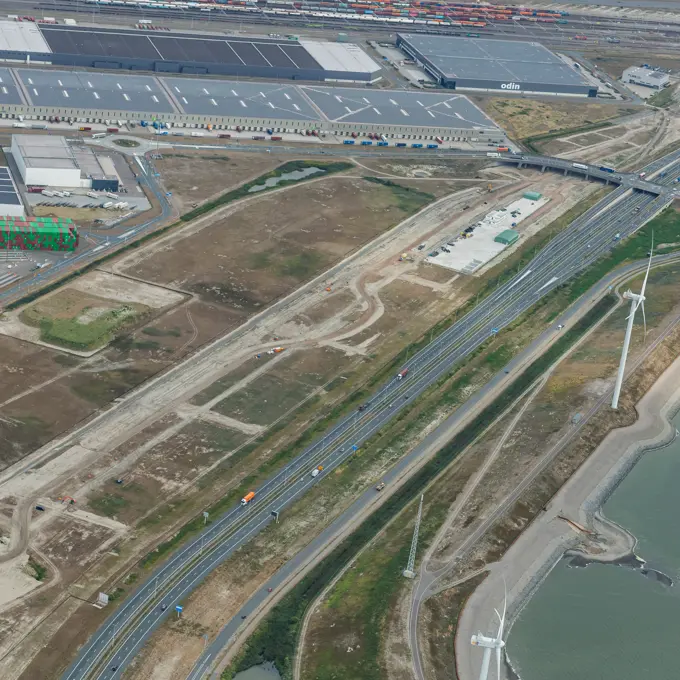
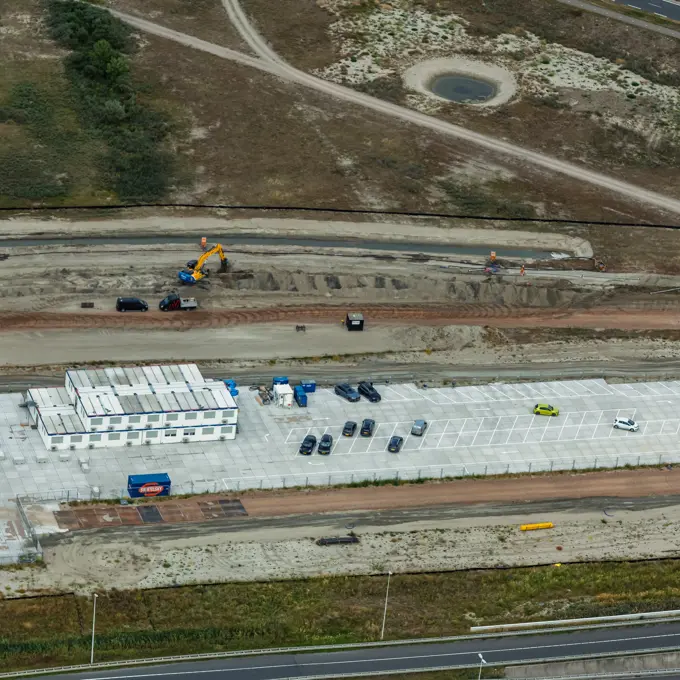
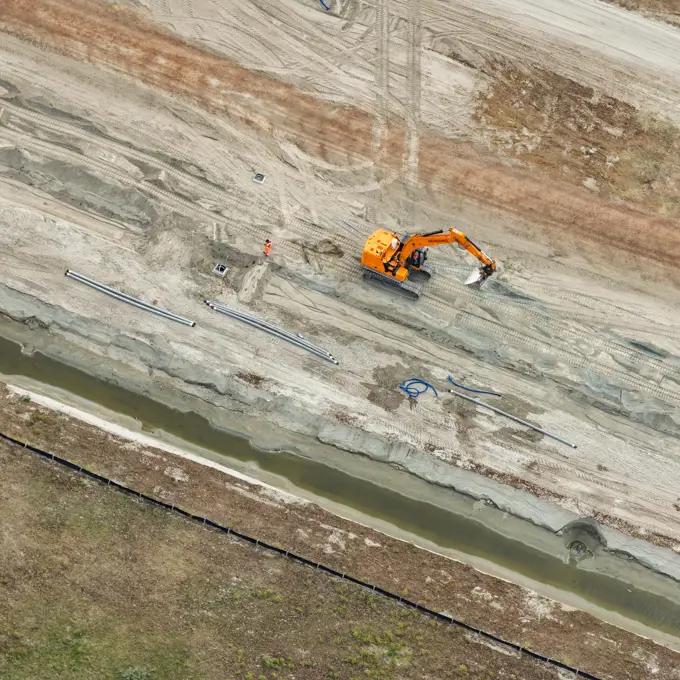
What is currently an almost vacant area of about 39 hectares is set to become Maasvlakte Zuid Yard (EMZ) by 2027. A new piece of track that will help keep the Port of Rotterdam well accessible in the future. Swietelsky Rail Benelux is responsible for the complete realization of the new yard as the main contractor.
Although the work is mainly taking place underground so far, many colleagues are already active on the project. Not surprising, according to project manager Alessio Suvaal, because this small area has everything in it. “We are literally building the track from the ground up. And we are taking full responsibility for the realization of the new yard: from design and preparation to execution and coordination. That requires a lot of craftsmanship and teamwork.”
Gaining time
The work has a number of peculiarities. For the Locomotive Workshop Rotterdam (LWR), a kind of APK station for locomotives, an underground cable tunnel of 84 meters needs to be pushed in. “To gain time, we are already building that structure in advance. This way, we only need to push it in during the shutdown in May 2026.” Additionally, there is a requirement to minimize construction traffic on the A15 and N15 as much as possible. Therefore, 23 kilometers of rail, 17,500 sleepers, 50,000 tons of ballast, and 34 switches will be delivered by ship starting in January via one of the terminals on the Maasvlakte. Swietelsky will then take care of the further transport to the project site.
Consciously advancing for efficient execution
“We are also installing a 23 kV power supply within this assignment, as one of the first in the Netherlands. This is a new type of power supply that will power everything from train safety to yard lighting and the complete setup. We have consciously brought this work forward and will realize this facility in January 2026. This way, we can charge our electric krol and use it for a year.”
Additionally, the installation of a switch for the connection to the rail network has been consciously advanced. “Heavy stop machines are needed for the new crossover switch complex. We want to deploy them directly from June 2026. Unfortunately, a lighter, hoistable variant is not sufficient, so we need to transport the machines by rail. A connection is necessary for that. Originally, the final switch was to be placed only at Easter 2027, at the end of the work. We have chosen to do this during the shutdown in May 2026, when we push in the cable tunnel for the LWR. This way, we can carry out the stop work timely and efficiently from June.”
Vacant, but far from quiet
Working on the Maasvlakte also means building in a dynamic port area. “We are very aware of that,” says Alessio. “And we communicate this to everyone on the project.” Although the area is still relatively vacant, it is far from simple. There is a lot happening in the area, especially underground. There are cables and pipelines from TenneT and telecom providers, as well as sewage systems. “That’s why we must work in a highly predictable manner: thoroughly analyze everything, develop a solid plan of action, and make clear agreements about execution.” Ecology also requires attention. “There are about 8.5 kilometers of toad screens, with which we move toads in a controlled manner. To prevent nesting birds on the construction site, we take preventive measures before the breeding season. Such as using lasers and specially trained dogs to move birds in a humane way. All in close collaboration with our project ecologist.”
Seamlessly combining
What makes this project further special is that a large part of the work will not be visible afterwards. About 30 percent consists of cables and pipelines, and only a quarter of traditional rail construction. “Swietelsky is, of course, originally a rail builder,” explains Alessio. “We are used to working in short train-free periods, where the work must be completed within 52 hours. This often happens at night, on weekends, or during holiday periods. This makes this project really different: we mainly work during the day here and have hardly any fixed frameworks.” Additionally, Alessio sees that the conditions and additional components are becoming increasingly important. “In this project, we seamlessly combine civil engineering, rail construction, electrical engineering, project management, and stakeholder communication. It shows that we are a multidisciplinary organization with expertise. We are not just building rail; we are contributing to the future of mobility and logistics.”
- Alessio Suvaal - Projectmanager EMZ