On behalf of the Port of Rotterdam Authority, Swietelsky will deliver the first phase of Maasvlakte Zuid (EMZ)—a new rail yard—between 2025 and 2027, as part of the “Logistics Vision for Rail Freight” programme, in cooperation with ProRail and with CEF funding.
The construction of the EMZ is necessary to facilitate the growth of rail freight transport from Maasvlakte to the European hinterland. It will resolve the current capacity bottleneck. For Rotterdam’s position in the European hinterland, a reliable and competitive rail product is indispensable. Container throughput in the Port of Rotterdam will continue to grow steadily in the coming years. To ensure that the increasing flow of containers can continue to be transported to the hinterland efficiently, the Port of Rotterdam Authority, ProRail and the Ministry of Infrastructure and Water Management are investing in sustainable and efficient rail development.
Project update - Summer 2026
Considerable progress has been made this summer on the construction of the relay houses at the Maasvlakte. The structural shells have been completed, and the technical installation and fit-out of relay house 200 is now under way. The train protection team is currently installing the cabinets, after which the wiring can be routed into the relay house.
The installation contractors are equally busy. Their work includes fitting cable trays and installing the technical systems in the various rooms of the relay houses.
Outside the buildings, the trenches for the cables and fibre-optic cables are currently being excavated. The cables themselves will be brought into the relay houses this autumn, establishing the connections with the various system components.
In addition, work has started on laying the cables required to connect the different systems and cabinets. The finishing works on the track are also progressing, including the rail access points and inspection paths.
The low-voltage works are likewise in full swing, with lighting and point heating being installed. All in all, there is a great deal of activity at the Maasvlakte this summer, with clearly visible progress both inside and around the relay houses.


Project update - May 2026
During a 130-hour train-free period, Swietelsky reached an important milestone at Maasvlakte South. A double concrete cable tunnel was successfully slid underneath the tracks. And it was quite a precision operation. The tunnel, over 84 metres long and made up of 28 precast concrete elements, was prepared in advance next to the tracks. The complete structure — around 1.25 million kilos of concrete — was then carefully moved into its final position beneath the tracks.


Project update - March / april 2026
Over the past few weeks, a great deal of work has been carried out on the new railway line. The outline of the railway infrastructure is becoming clearly visible at Maasvlakte Zuid. Part of the ballast bed has been laid, work on installing the overhead lines is in full swing, and a large proportion of the points have already been laid.


Project update – February 2026
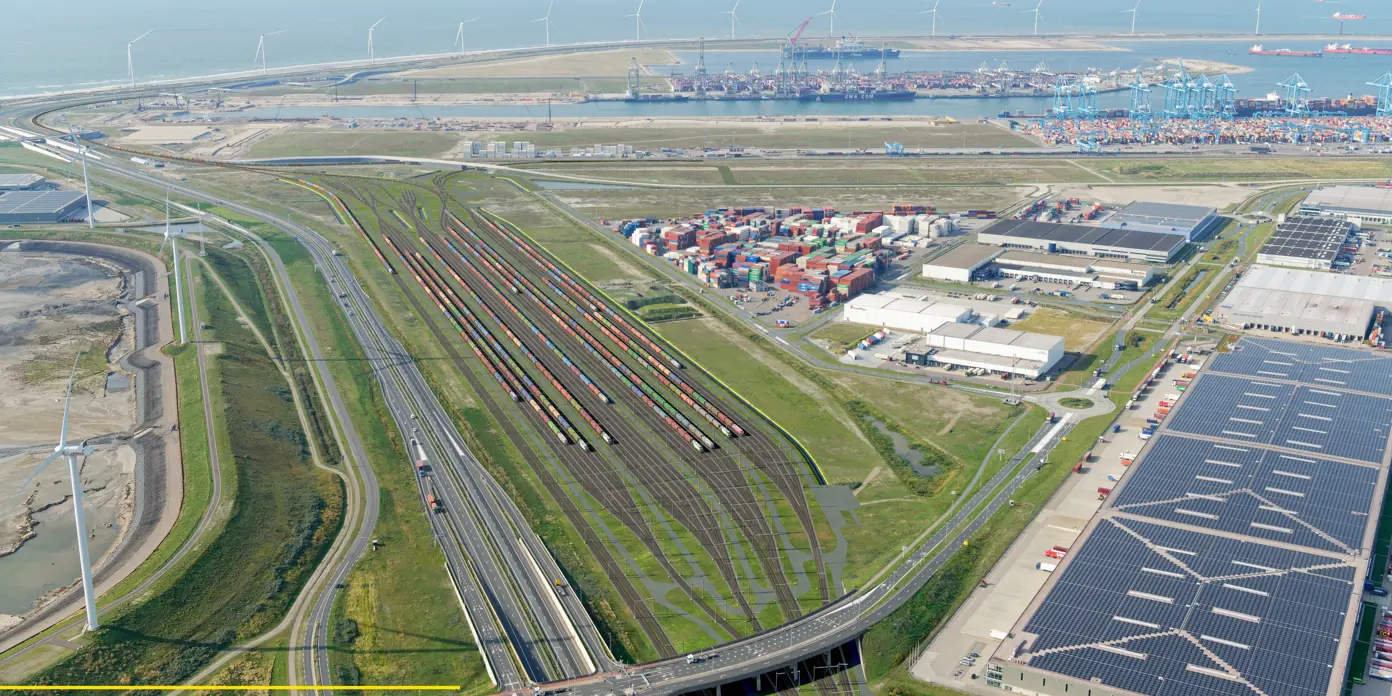
From sand flats to a future-proof rail yard: the first visible steps have been taken at Maasvlakte Zuid Rail Yard.
Where there was only sand a few months ago, the first metres of new track are now in place. The foundations and masts for the first overhead line gantries have also been erected. In early February, the first turnouts were installed for the Maasvlakte Zuid rail yard. The turnouts, each weighing more than 30 tonnes, were lifted into position using a mobile crane. This is precision work, with the turnouts installed to millimetre accuracy. Another 30 turnouts to go.


Project update – January 2026
After the first months of earthworks, we are now moving into the build phase. This means bringing in large quantities of materials—and we are doing so as sustainably as possible.
To limit CO₂ emissions, we transport construction materials such as track ballast, sleepers, rails and turnouts by ship to the Rhenus Deep Sea Terminal on Antarcticaweg. From there, the materials are transported by road to the site. In this way, we make optimal use of inland shipping and reduce the number of road transport kilometres.
The scale of this project in figures:
- 50,000 tonnes of track ballast
- 17,079 sleepers
- 22,248 metres of rails (618 pieces of 36 metres)
- 34 turnouts
- 13 kilometres of overhead line equipment
A major logistics operation, where sustainability and efficiency go hand in hand. This way, we are building not only infrastructure, but also a future-proof rail freight system.


Project scope
This first phase of the EMZ project includes the construction of the first group of six tracks and various connections to the existing rail infrastructure. The new rail yard is needed to accommodate the increasing flow of freight by rail between Maasvlakte and the European hinterland. The first track group is scheduled to enter service in mid-2027. Swietelsky Rail Benelux B.V. is responsible for the construction of:
- Track group 1: 12 km of track including 25 kV overhead line equipment (OLE);
- 34 turnouts;
- Two relay houses for approximately 100 new axle counters;
- One AT station;
- A 23 kV power supply route for train protection and yard systems;
- Emergency access roads and 8 level crossings;
- Firefighting facilities;
- Yard systems such as access gates, fencing, CCTV and lighting;
- Adjustments to water management and the creation of a new dune area.
Achieving climate targets
The construction of EMZ aligns with the Port Authority’s ambition to promote rail freight transport. Rail freight has lower emissions of CO₂, NOₓ and particulate matter than road transport. This supports the EU Green Deal climate targets, which aim to reduce transport emissions by 55% by 2030 and by 90% by 2050.
The development of EMZ helps the Port of Rotterdam Authority reduce CO₂ emissions from hinterland and continental transport by 30% by 2030, in line with the Dutch Climate Agreement. With EMZ in place, the Port Authority expects to enable the formation of an additional 6,750 trains per year between Maasvlakte and the hinterland. This is equivalent to replacing 675,000 truck journeys annually.
Optimising rail freight transport
The Port of Rotterdam Authority and ProRail have developed the “Logistieke Visie Havenspoor 2050”. This vision provides insight into future capacity bottlenecks on the Port Railway Line and how they can be addressed. Up to 2040, a number of infrastructure projects are planned to increase rail accessibility to Maasvlakte and to optimise and decarbonise logistics processes. These projects will be delivered in phases in cooperation with ProRail. In addition to the construction of EMZ, the C2 curve will be modified and further electrification of the Port Railway Line will be pursued.
The project from above
Follow the progress of the Maasvlakte Zuid Rail Yard project from the air.


