Commissioned by ProRail, Swietelsky Rail Benelux is working in Hurdegaryp together with Haskoning and Boskalis Nederland to strengthen the rail track and railway embankment using geotextile-encased stone columns. This innovative geotechnical technique provides sustainable subsoil stabilisation without opening up the track, causing minimal disruption to rail traffic.
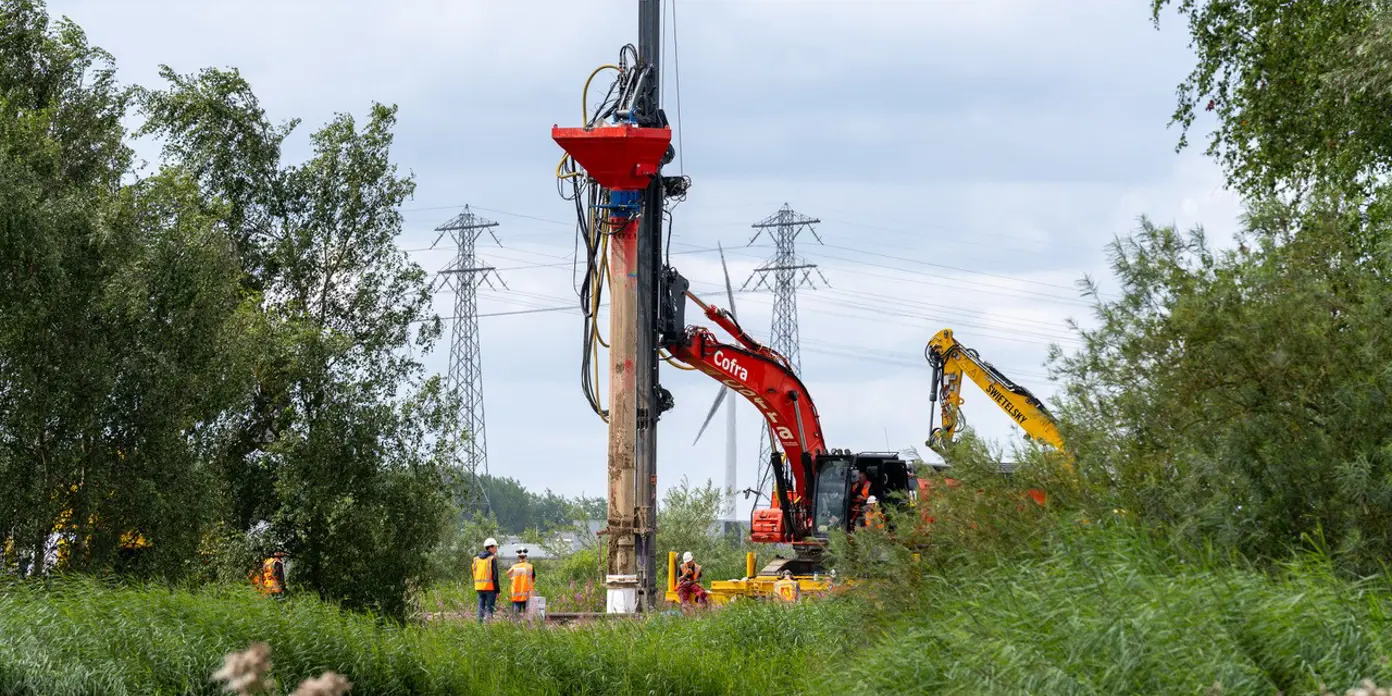
A first in Hurdegaryp, Friesland, where Haskoning, Boskalis Nederland and Swietelsky, commissioned by ProRail, are installing geotextile-encased stone columns using vibroflot technology to reinforce the rail track and railway embankment. It is a well-known challenge for ProRail: the railway embankment is slowly subsiding, while trains run across soft clay and peat soils.
The solution involves installing large gravel-filled sleeves (columns) vertically into the ground, acting as a foundation that makes the soil more stable and stronger. The result is a sustainable innovation that improves the entire track structure and railway formation without opening up the track. This is now being carried out on an operational railway line with hardly any disruption, which makes it particularly remarkable.
The Champions League of Geotechnics
ProRail commissioned a consortium of specialists, including Haskoning, Swietelsky Rail Benelux and Boskalis Nederland, to significantly improve track stability in a sustainable way. The stone columns form a new foundation for the railway embankment and are installed vertically into the ground between and alongside the sleepers.
These stone columns have now been installed beneath the track in Friesland. The final column was placed in the first week of August. “After that, the ballast is put back and trains can safely run over it again. The intervention has minimal impact on rail traffic, and we have equipped the subsoil with sensors so that we can understand exactly what happens underground when a train passes over it. With that knowledge, we continue to improve. You could say that this combination of design and execution is the Champions League of geotechnics,” said Jelle van der Zon, geotechnical engineer at Haskoning.


A More Sustainable Alternative
“The solution of using stone columns as foundations in the railway embankment is considerably more sustainable than the steel sheet piles currently being used. From a societal perspective, it is also more attractive than a solution based on berm reinforcement,” says Arjan Dirven, Project Manager at Swietelsky. The ballast material used (gravel) increases the stability of the rail track. The consortium sees the use of recycled ballast material as an opportunity to further improve sustainability. “The combined expertise in design, execution and monitoring forms the basis for this further development,” adds André de Lange, involved in ground improvement through COFRA at Boskalis Nederland.
The next twelve months will consist of a monitoring phase. If the results are positive, this technique can be applied more widely to future-proof subsiding railway embankments and rail tracks across the Netherlands.
For questions, more information or interview requests, please contact nicoline.mezger@haskoning.com or +31 6 33002133.